Neck Isometrics
Isometric exercises work the neck muscles without moving the neck. You press your head gently into your own hand while the hand stops any movement. Because the neck stays still, they suit painful necks and cervical spondylosis, and they are often the first strengthening exercise for the neck.
Written by Dr. V. B. Rajendra Prasad, MPT, licensed in the US and UK.
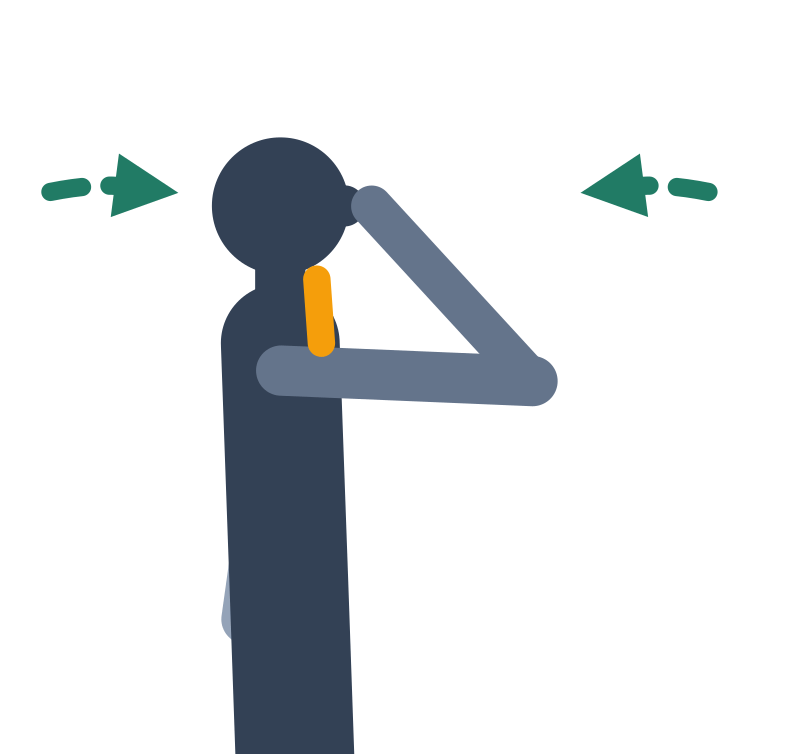

How to do it
- 1
Sit tall in a chair with your back supported, chin level and shoulders relaxed.
- 2
Place your palm on your forehead. Press your head forward into your hand gently, while the hand stops it from moving. Hold, then relax.
- 3
Place your hand on the back of your head and press the head back into it. Hold, then relax.
- 4
Place your hand on the side of your head, above the ear. Press the head sideways into the hand. Hold, then relax. Repeat on the other side.
- 5
Breathe normally throughout. The head should not move at all.
How many
Use about a quarter of your full effort. Hold each press for 5 to 10 seconds, 5 times in each direction, once or twice a day.
Common mistakes
Pushing too hard. Gentle pressure is enough. Strong pushing can provoke pain.
Letting the head move. The hand and head should be balanced, so nothing moves.
Holding your breath. Breathe out slowly as you press.
Shrugging the shoulders. Keep them down and relaxed.
Make it easier
Press more gently, for 3 to 5 seconds, or start with only the directions that feel comfortable.
Make it harder
Build up to 10 second holds with a little more effort. Your physiotherapist will move you on to chin tucks with a head lift and upper back strengthening.
Who it helps
When to stop and check
Stop and get checked if pressing brings on pain, numbness or tingling down an arm, dizziness, or changes in vision. Seek urgent medical help for neck pain after a fall or accident, or with weakness or clumsiness in the arms or legs.
Are you doing it right? Book a form check
One live 1-hour video session with a Nuprana physiotherapist, for this exercise and any others you have been given.
- Observe: they watch you do each exercise, from the angles that matter.
- Correct: they fix your position, range and speed as you go, so the right muscles do the work.
- Teach: you finish knowing how many to do, how it should feel, and when to make it harder.
₹649, from home, anywhere in India. If you are in pain or recovering from surgery, the physiotherapist will tell you what else would help.
Book a form checkFrequently asked questions
Are isometric neck exercises good for cervical spondylosis?
How hard should I press?
Can I stop wearing my neck collar if I do these?
Related
More neck and shoulder exercises

Written by Dr. V. B. Rajendra Prasad, MPT. Licensed to practice in the US (NY state) and UK (HCPC).
20 years of clinical experience. About Dr. Rajendra