Lying Toe Taps
Lying toe taps train the deep tummy muscles to hold the trunk steady while the legs move. Because you lie on your back and the load is small, they suit the weeks after childbirth, when the tummy muscles are stretched and there may be a gap down the middle (diastasis recti). They follow on from core breathing, and lead towards harder exercises such as the dead bug.
Written by Dr. V. B. Rajendra Prasad, MPT, licensed in the US and UK.
How to do it
- 1
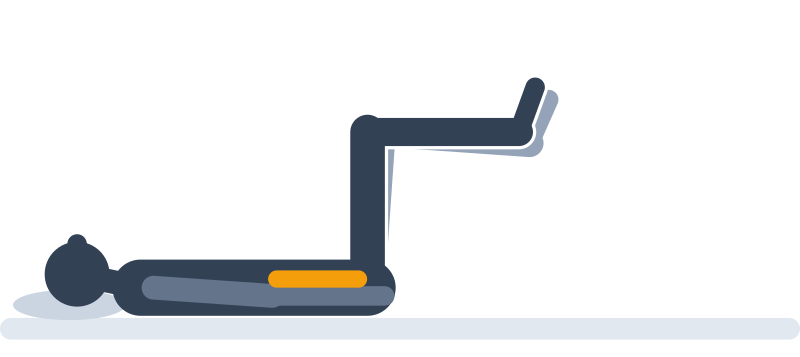
Lie on your back with your knees bent and feet flat, arms by your sides. Take a breath in.
- 2
As you breathe out, gently lift the pelvic floor and draw the lower tummy in. Keep your lower back resting on the floor, without pressing it down hard.
- 3
Lift one foot so the knee comes over the hip, with the knee bent to a right angle. Then bring the other leg up to match.
- 4
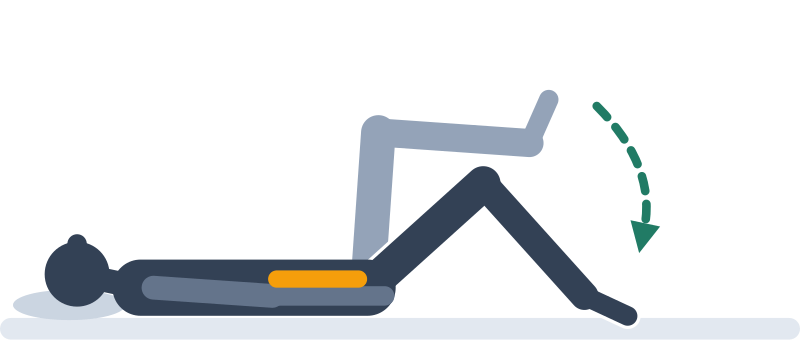
Keeping the knee bent, slowly lower one foot until the toes tap the floor, then bring it back up. Breathe out as the leg goes down.
- 5
Tap with the other foot. Keep the tummy flat and the lower back still throughout. Lower both feet, one at a time, to finish.
How many
6 to 10 taps with each leg, 2 sets, once a day. Quality matters more than numbers: stop the set when the tummy starts to bulge or the back arches.
Common mistakes
The tummy doming or bulging up along the middle as the leg moves. This means the load is too much for now. Go back to the easier version.
Arching the lower back as the foot goes down. Move a smaller distance, or keep one foot on the floor.
Holding your breath. Breathe out as each leg lowers.
Letting the leg drop quickly. Lower it slowly and with control.
Pressing the back flat by tucking the pelvis hard. Aim for a still, relaxed back, not a squeezed one.
Make it easier
Keep one foot on the floor and lift the other knee up over the hip, then lower it, alternating sides. Or slide one heel along the floor away from you and back while you keep the tummy drawn in.
Make it harder
Lower the foot more slowly, or tap the heel further away from you so the leg is longer. Later, add the opposite arm reaching back over your head, as in the dead bug.
Who it helps
When to stop and check
After a vaginal birth these usually start after the first couple of weeks, once core breathing is easy. After a caesarean, wait until the wound is comfortable and your doctor or physiotherapist agrees, often around 6 weeks. Stop if you feel pain in the scar or the back, or heaviness or leaking from below. If the tummy domes with every tap, ask a physiotherapist to check your tummy gap.
Are you doing it right? Book a form check
One live 1-hour video session with a Nuprana physiotherapist, for this exercise and any others you have been given. You can ask for a female physiotherapist, and we will match that request.
- Observe: they watch you do each exercise, from the angles that matter.
- Correct: they fix your position, range and speed as you go, so the right muscles do the work.
- Teach: you finish knowing how many to do, how it should feel, and when to make it harder.
Nothing to undress. Wear comfortable clothes you can move in; the camera only needs to see how you move.
₹649, from home, anywhere in India. If you are in pain or recovering from surgery, the physiotherapist will tell you what else would help.
Book a form checkFrequently asked questions
Are toe taps safe with diastasis recti?
When can I start toe taps after a C-section?
Can I do sit-ups or crunches instead?
Related
More tummy and core exercises

Written by Dr. V. B. Rajendra Prasad, MPT. Licensed to practice in the US (NY state) and UK (HCPC).
20 years of clinical experience. About Dr. Rajendra