Core Breathing
Your breathing muscle (the diaphragm), your deep tummy muscles and your pelvic floor work as a team. When you breathe in, they relax and widen; when you breathe out, they gently tighten together. Core breathing retrains that teamwork. It is often the very first exercise after childbirth, a caesarean or surgery, because it is gentle, can be done lying in bed, and lays the foundation for everything that follows.
Written by Dr. V. B. Rajendra Prasad, MPT, licensed in the US and UK.
How to do it
- 1
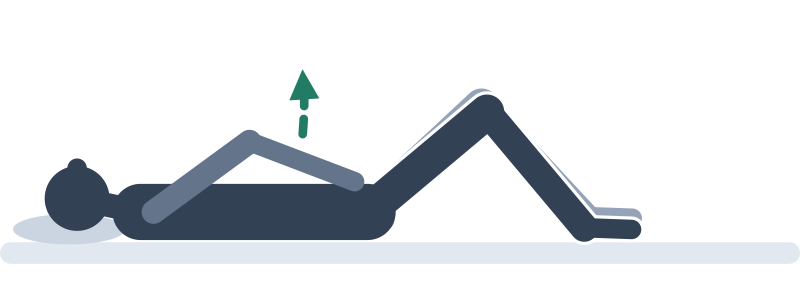
Lie on your back with your knees bent and feet flat, a pillow under your head. Rest one hand on your lower ribs or tummy.
- 2
Breathe in slowly through your nose. Let your lower ribs widen to the sides and your tummy rise under your hand. Let the pelvic floor relax and soften.
- 3
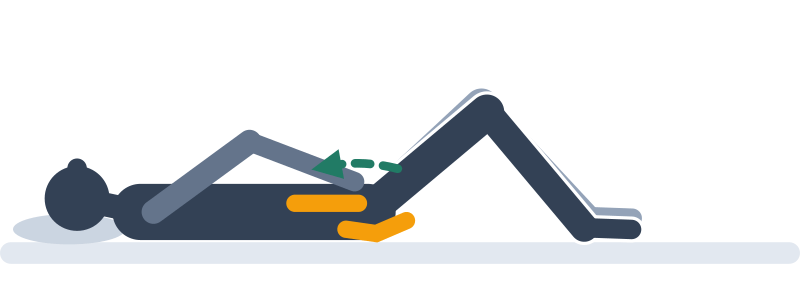
Breathe out slowly through your mouth, as if blowing through a straw. As you breathe out, gently lift the pelvic floor (as if stopping wind) and let the lower tummy, below the belly button, draw in a little.
- 4
Keep the effort gentle, about a quarter of your strongest squeeze. The upper tummy, buttocks and shoulders stay soft.
- 5
Let everything relax fully as you breathe in again. Repeat slowly.
How many
5 to 10 slow breaths, 3 or 4 times a day. Once it feels natural, do it sitting and standing, and use the same breath out whenever you lift, cough or get up.
Common mistakes
Breathing high into the chest and shoulders. Breathe low and wide, into the lower ribs and tummy.
Pulling the tummy in hard or sucking it in. The draw-in is light and low, below the belly button.
Holding your breath or pushing down. The lift happens on the breath out.
Breathing too fast or too deeply, which can make you dizzy. Slow and comfortable is enough.
Forgetting to relax on the breath in. The let-go matters as much as the lift.
Make it easier
Practise the breathing alone for a few days, without the pelvic floor lift. Lying on your side with a pillow between your knees can feel more comfortable after a caesarean or surgery.
Make it harder
Do it sitting, then standing, then while moving: breathe out and lift as you stand up from a chair, pick up your baby or carry shopping. Your physiotherapist will add exercises such as lying toe taps once the connection is there.
Who it helps
When to stop and check
Stop and rest if you feel dizzy or light-headed. After a caesarean or other surgery, hold a pillow firmly over the wound when you cough. See a doctor promptly for chest pain, sudden breathlessness, a painful swollen calf, fever, or redness or discharge from a wound. If you have a catheter in after prostate surgery, do the breathing only, and add the pelvic floor lift once the catheter is out.
Are you doing it right? Book a form check
One live 1-hour video session with a Nuprana physiotherapist. You can ask for a female or a male physiotherapist, and we will match that request.
- Observe: they watch your breathing, ribs and tummy, and ask what you feel, so they can tell whether the right muscles are working.
- Correct: they coach you to breathe low and wide, and to lift gently on the breath out without holding your breath, bearing down or clenching your buttocks.
- Teach: you finish knowing how many breaths to do, how it should feel, and when to move on to the next exercise.
Nothing to undress. You stay fully clothed, and the camera only needs to see your posture and breathing.
₹649, from home, anywhere in India. If you are in pain or recovering from surgery, the physiotherapist will tell you what else would help.
Book a form checkFrequently asked questions
How soon after delivery can I start core breathing?
Does core breathing help a tummy gap?
Why is breathing an exercise after breast cancer surgery?
Can men do core breathing?
Related
More tummy and core exercises

Written by Dr. V. B. Rajendra Prasad, MPT. Licensed to practice in the US (NY state) and UK (HCPC).
20 years of clinical experience. About Dr. Rajendra