Bridge
The bridge strengthens the buttock muscles (glutes), which support the lower back, hips and knees. Weak glutes are common in people who sit for long hours, and in many people with back and knee pain. The bridge is done lying down, so it is a good starting exercise for most people.
Written by Dr. V. B. Rajendra Prasad, MPT, licensed in the US and UK.
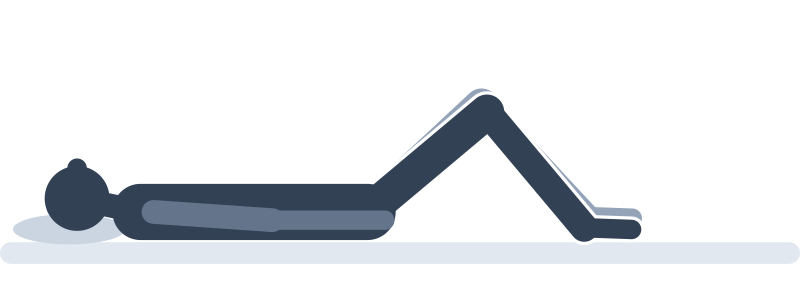
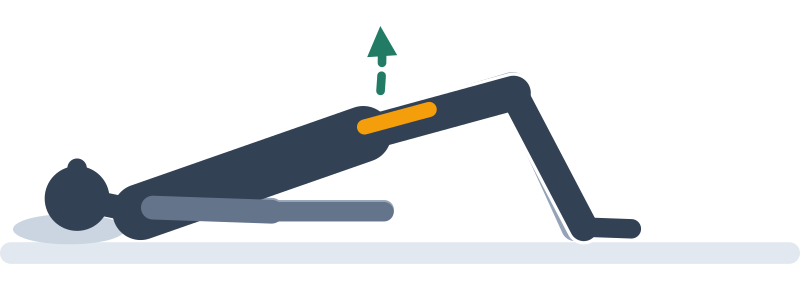
How to do it
- 1
Lie on your back with both knees bent, feet flat and hip-width apart, arms by your sides.
- 2
Gently tighten your tummy muscles and squeeze your buttocks.
- 3
Lift your hips off the bed or floor until your body forms a straight line from shoulders to knees.
- 4
Hold for 3 to 5 seconds, breathing normally.
- 5
Lower your hips slowly, one part of the spine at a time.
How many
10 repetitions, 2 sets, once a day. Build up to holding each bridge for 10 seconds.
Common mistakes
Lifting too high and arching the back. Stop when the body is in a straight line.
Pushing with the back instead of the buttocks. Squeeze the buttocks first, then lift.
Feet too close or too far away. With the feet too far away the hamstrings cramp.
Holding your breath.
Make it easier
Lift only a few centimetres to begin with, or simply squeeze and relax the buttocks without lifting.
Make it harder
Hold for longer, march slowly on the spot while holding the bridge, or lift one foot off the floor (single-leg bridge).
Who it helps
When to stop and check
Stop if the exercise causes sharp back pain or pain going down the leg. After hip replacement, check with your physiotherapist before starting. In later pregnancy, lying flat on the back may not suit you, so ask your physiotherapist for an alternative.
Are you doing it right? Book a form check
One live 1-hour video session with a Nuprana physiotherapist, for this exercise and any others you have been given.
- Observe: they watch you do each exercise, from the angles that matter.
- Correct: they fix your position, range and speed as you go, so the right muscles do the work.
- Teach: you finish knowing how many to do, how it should feel, and when to make it harder.
₹649, from home, anywhere in India. If you are in pain or recovering from surgery, the physiotherapist will tell you what else would help.
Book a form checkFrequently asked questions
Is the bridge good for lower back pain?
Why do I feel the bridge in my hamstrings instead of my buttocks?
Related
More hip and buttocks exercises

Written by Dr. V. B. Rajendra Prasad, MPT. Licensed to practice in the US (NY state) and UK (HCPC).
20 years of clinical experience. About Dr. Rajendra